
What is a Lateral Extra-Articular Tenodesis (LET)?
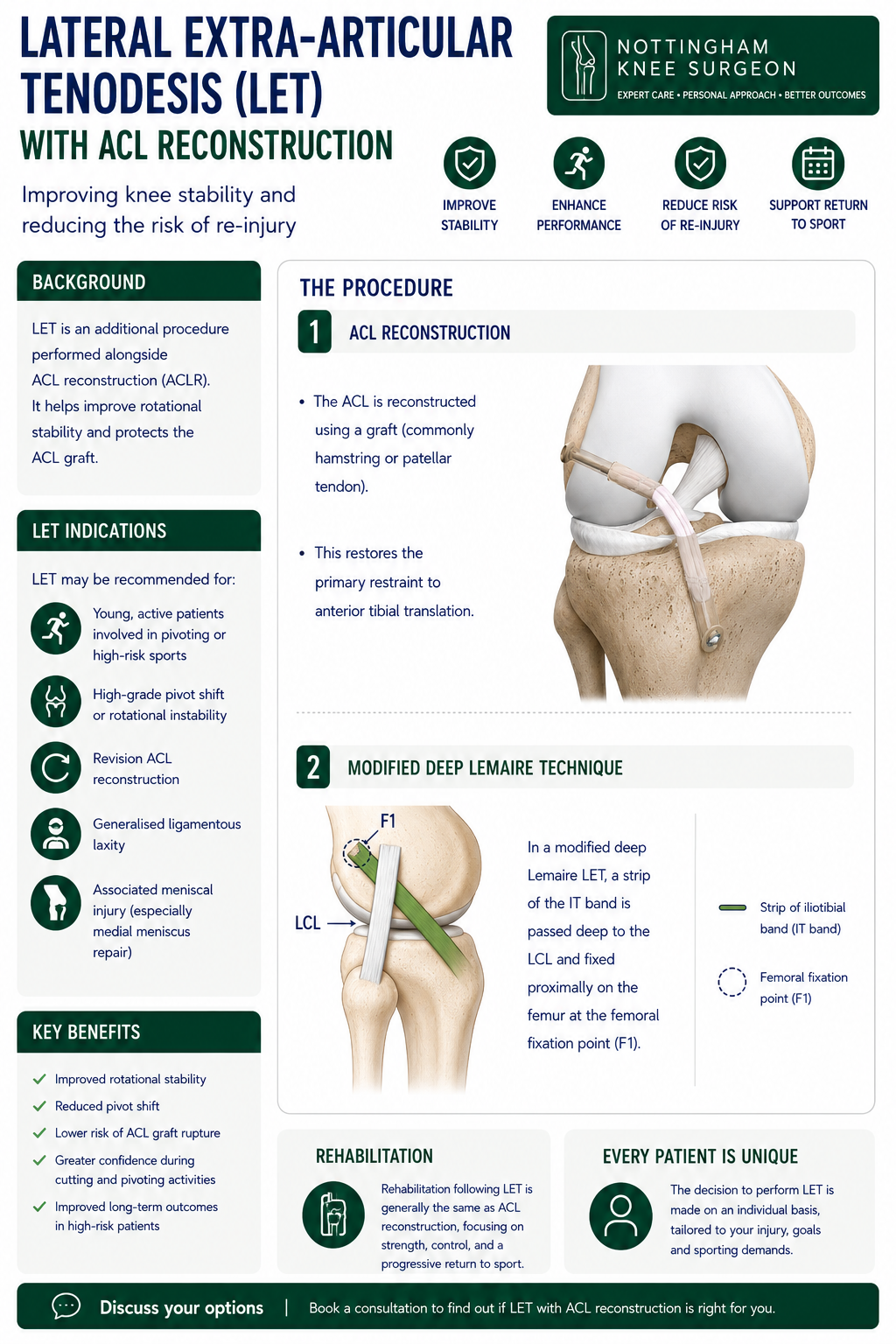
A Lateral Extra-Articular Tenodesis (LET) is an additional procedure that can be performed alongside an anterior cruciate ligament (ACL) reconstruction to improve rotational stability of the knee.
During the procedure, a small strip of the iliotibial band (IT band) on the outside of the thigh is used to reinforce the outer aspect of the knee. This helps control excessive internal rotation of the tibia and reduces the stress placed on the reconstructed ACL graft.
The procedure is most commonly performed at the same time as ACL reconstruction in patients who are at higher risk of re-injury or persistent instability.
Why Might an LET Be Added to ACL Reconstruction?
Modern ACL reconstruction is highly successful, but some patients remain at increased risk of graft failure or recurrent instability.
Research over the last decade has shown that adding an LET to ACL reconstruction can:
- Improve rotational stability
- Reduce the pivot shift phenomenon
- Reduce strain on the ACL graft
- Lower the risk of graft rupture
- Improve confidence during cutting and pivoting sports
Several high-quality studies have demonstrated lower re-rupture and failure rates when LET is added to ACL reconstruction in selected high-risk patients.
Who May Benefit From LET?
Who May Benefit From LET?
Not every patient requires an LET. The decision is individualised based on injury pattern, sporting demands and examination findings.
Patients who may benefit include:
Young Athletes
Patients under 25 years of age returning to pivoting sports such as:
- Football
- Rugby
- Netball
- Basketball
- Skiing
High-Grade Rotational Instability
Patients demonstrating a significant pivot shift on examination, indicating excessive rotational instability of the knee.
Revision ACL Reconstruction
Patients undergoing a second ACL reconstruction after a previous graft failure often benefit from additional rotational control provided by LET.
Generalised Ligamentous Laxity
Individuals who are naturally very flexible or hypermobile may have a higher risk of graft stretching and failure.
Associated Meniscal Injury
Patients undergoing meniscal repair, particularly of the medial meniscus, may benefit from the additional stability provided by LET.
How Is the Procedure Performed?
The LET is performed through a small incision on the outside (lateral) of the knee.
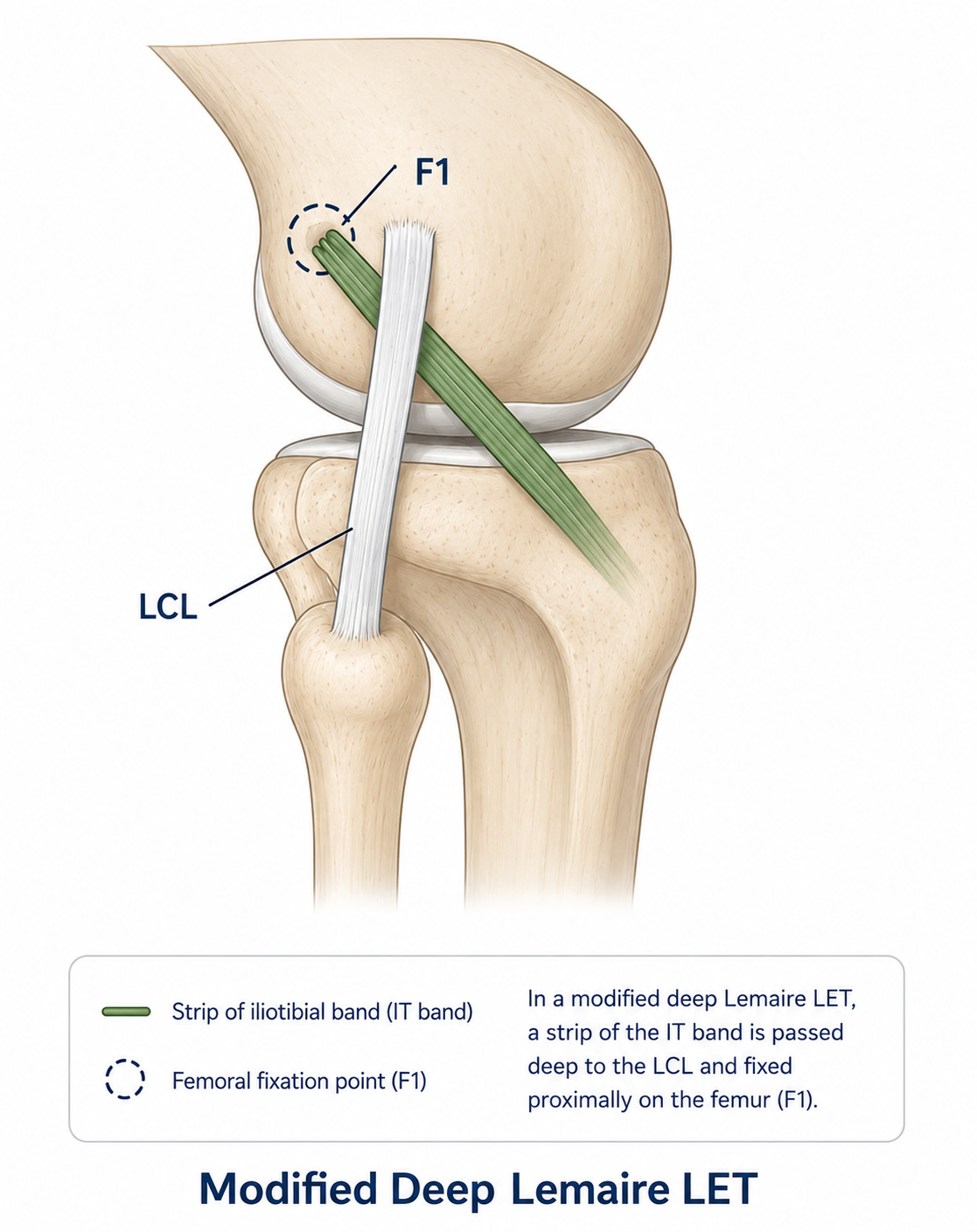
A strip of the iliotibial band is left attached at one end, passed beneath the lateral collateral ligament and secured to the femur.
The procedure typically adds only a small amount of surgical time to a standard ACL reconstruction.
This is called the modified Lemaire LET which is the technique I use routinely.
What Are the Benefits?
Potential benefits include:
- Lower risk of ACL graft rupture
- Improved rotational stability
- Better control during cutting and pivoting movements
- Reduced risk of revision surgery
- Greater confidence when returning to sport
Meta-analyses have demonstrated lower graft failure rates when LET is combined with ACL reconstruction compared with ACL reconstruction alone.
Does LET Change Rehabilitation?
There is no change to your ACL rehab with the addition of LET. However, it may slow down your early recovery in the first 4-6 weeks due to the additional surgical trauma of the procedure.
Are There Any Risks?
As with any surgical procedure, LET carries potential risks, including:
- Pain on the outside of the knee
- Temporary stiffness
- Scar sensitivity
- Infection
- Bleeding
- Nerve irritation
- Over-constraint of the knee (rare) – evidence shows very low risk of this with modern procedures and rehab
However, with modern and meticulous surgical technique, we have seen very few complications.
Frequently Asked Questions
Will I notice the LET after surgery?
Most patients are unaware of the LET once they have fully recovered. Some patients notice temporary tenderness on the outside of the knee during the early stages of rehabilitation. Patient-reported experiences commonly suggest increased early lateral-sided discomfort but improved stability over time.
Does LET replace ACL reconstruction?
No. LET is not a substitute for ACL reconstruction. It is an additional procedure designed to protect and support the reconstructed ACL.
Will LET affect my ability to return to sport?
The goal of LET is to improve stability and reduce the risk of re-injury, particularly in athletes participating in pivoting sports.
My Approach
I commonly consider LET as an adjunct to ACL reconstruction in young athletes, revision ACL surgery, patients with significant rotational instability, and those returning to high-risk pivoting sports.
The decision to perform LET is made on an individual basis following a detailed clinical assessment, imaging review and discussion of your sporting goals.
If you have suffered an ACL injury and would like to discuss whether an LET may be appropriate in your case, please arrange a consultation.