
Which Graft Should I Choose for My ACL Reconstruction?
Understanding Your Options
One of the most common questions I am asked by patients considering ACL reconstruction is:
“Which graft should I choose?”
Unfortunately, there is no single “best” graft for everyone. The ideal graft depends on your age, sporting goals, occupation, anatomy, previous surgery, and personal preferences.
Modern ACL reconstruction is highly successful, with most patients returning to sport and active lifestyles. However, selecting the most appropriate graft can influence recovery, strength, kneeling comfort, and potentially the risk of reinjury.
In this article, I explain the advantages and disadvantages of the most commonly used grafts for ACL reconstruction.
What Is an ACL Graft?
During ACL reconstruction, the torn ligament is replaced with a new tendon graft.
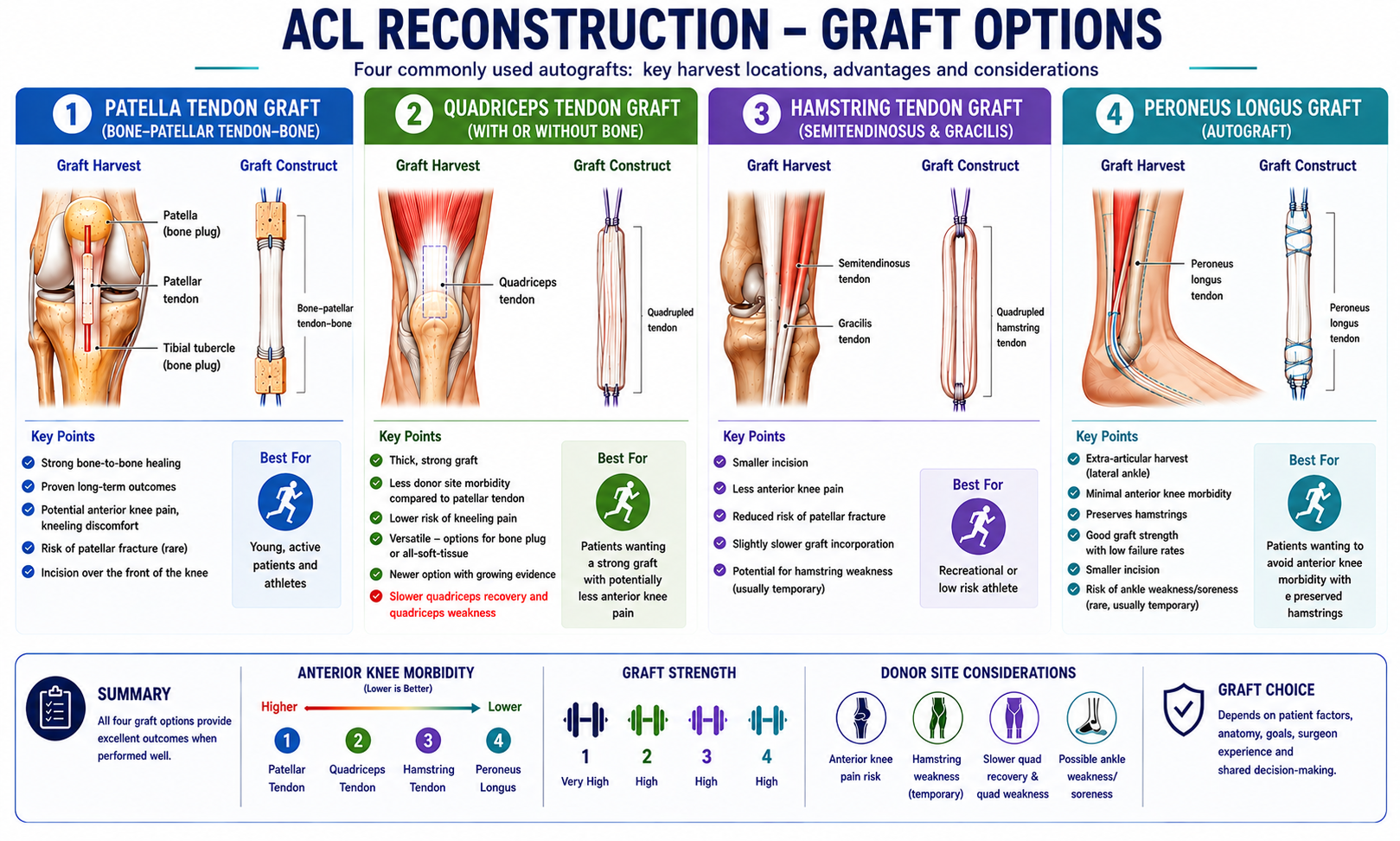
The most commonly used grafts are:
- Hamstring tendon autograft
- Quadriceps tendon autograft
- Patellar tendon autograft
- Allograft (donor tissue)
- Peroneus longus and rectus femoris graft (less common in the UK)
The graft acts as a scaffold that gradually incorporates into the knee and functions as a new ACL.
Hamstring Tendon Graft
Traditionally, hamstring tendons have been one of the most commonly used grafts worldwide.
The semitendinosus tendon, sometimes combined with the gracilis tendon, is harvested through a small incision on the inside of the knee.
Advantages
- Smaller incision
- Less pain when kneeling
- Excellent long-term outcomes
- Lower risk of anterior knee pain compared with patellar tendon grafts
Disadvantages
- Potential hamstring weakness
- Slower graft incorporation compared with some other grafts
- Higher re-rupture rates in some young, high-demand athletes
Best Suited For
- Recreational athletes
- Patients wishing to avoid kneeling pain
- Individuals not heavily dependent on hamstring strength
Quadriceps Tendon Graft
Quadriceps tendon grafts have become increasingly popular over the past decade and are now widely used in sports knee surgery.
The graft is taken from the tendon above the kneecap.
Advantages
- Large, robust graft
- Lower donor site pain than patellar tendon grafts
- Excellent strength characteristics
- Low rates of graft failure
- Suitable for both primary and revision ACL reconstruction
Disadvantages
- Quadriceps weakness and slower quadriceps recovery
- Potential discomfort at the harvest site
- Rehabilitation may initially focus more heavily on restoring quadriceps strength
Best Suited For
- Young athletes
- Pivoting sports such as football, rugby and netball
- Patients at higher risk of graft failure
- Revision ACL surgery
- Patients who want to avoid risk of kneeling discomfort with patella tendon graft
Patellar Tendon Graft
The patellar tendon graft has historically been considered the “gold standard” for ACL reconstruction.
The central third of the patellar tendon is harvested along with small pieces of bone from the kneecap and tibia.
Advantages
- Excellent fixation strength
- Rapid bone-to-bone healing
- Excellent long-term results
- Lower graft failure rates in some studies of elite athletes
Disadvantages
- Increased risk of anterior knee pain
- Pain when kneeling
- Rare risk of patella fracture or patellar tendon injury
- Potential long-term discomfort around the front of the knee
Best Suited For
- Elite athletes
- High-level pivoting sports
- Patients where minimising graft failure risk is the primary goal
I use a minimally invasive harvesting technique with meticulous closure of tissue layers and bone grafting of harvest sites to promote bone growth and reduce risk of anterior knee pain and kneeling pain.
Peroneus Longus Tendon Graft
The peroneus longus tendon is harvested from the outer side of the ankle and lower leg.
Although less commonly used than the traditional grafts, growing evidence suggests that it is a safe and effective option for ACL reconstruction.
Advantages
- Minimal anterior knee morbidity
- Preserves the hamstring tendons
- Preserves the extensor mechanism of the knee
- Good graft diameter and strength
- Low reported failure rates
- Small incision
Potential Disadvantages
- Potential ankle weakness or soreness
- Less long-term evidence than traditional grafts
- Not universally offered by all surgeons
Best For
- Patients wishing to avoid knee donor-site symptoms
- Patients with previous hamstring harvest
- Revision ACL reconstruction
- Individuals requiring preservation of quadriceps and hamstring strength
Allograft (Donor Tissue)
An allograft uses tendon tissue from a donor.
No tendon is harvested from the patient’s own body.
Advantages
- Smaller surgical incisions
- Less postoperative pain
- Faster early recovery
- Useful in revision surgery
Disadvantages
- Higher failure rates in young active patients
- Slower biological incorporation
- Small theoretical risk of disease transmission
Best Suited For
- Older patients
- Lower-demand athletes
- Selected revision cases
Most surgeons would not recommend allografts for young athletes returning to pivoting sports.
Which Graft Has the Lowest Failure Rate?
Research suggests that graft failure rates are influenced by:
- Age
- Return-to-sport timing
- Rehabilitation quality
- Sporting demands
- Surgical technique
Rather than graft choice alone.
However, current evidence generally suggests:
- Patellar tendon and quadriceps tendon grafts may have lower failure rates in young athletes.
- Hamstring grafts remain highly successful but have higher re-rupture rates in some high-risk populations.
- Peroneus longus grafts have low failure rate and emerging as a promising option but is not commonly used in the UK currently.
- Allografts have the highest failure rates in young active patients.
Which Graft Is Best for Footballers?
For footballers, rugby players and athletes involved in cutting and pivoting sports, the 2 main options are:
- Quadriceps tendon graft
- Patellar tendon graft
Both provide excellent stability and have demonstrated strong return-to-sport outcomes.
I prefer patellar tendon graft for this group of patients for the lowest risk of failure and better quadriceps strength recovery compared to quads. The risk of anterior knee pain and kneeling pain can be minimised by good surgical technique.
Which Graft Is Best for Recreational Athletes?
For recreational athletes, all four autograft options can provide excellent outcomes.
The decision often comes down to balancing:
- Risk of kneeling pain
- Recovery priorities
- Sporting goals
- Previous injuries
- Individual anatomy
My Approach to ACL Graft Selection
I believe ACL graft selection should be individualised.
There is no “one-size-fits-all” solution.
During consultation, we discuss:
- Your age
- Sporting ambitions
- Occupation
- Previous injuries
- Anatomical factors
- Personal preferences
Together we select the graft that offers the best balance of stability, recovery and long-term function.
Frequently Asked Questions
Which ACL graft is strongest?
All modern autografts are stronger than the native ACL at the time of implantation. Long-term success depends more on biological healing, rehabilitation and return-to-sport decisions than initial graft strength.
Will harvesting a tendon make me weaker?
Temporary weakness is expected after graft harvest. Most patients regain excellent strength with appropriate rehabilitation.
Can I return to football after ACL reconstruction?
Yes. Most patients can return to football following successful ACL reconstruction and rehabilitation, although return-to-sport timelines vary between individuals.
Return to sports is based on graft incorporation (minimum 9 months and recommended 1 year for recreational athlete) and passing return to sports criteria – both physical and psychological readiness.
Our rehab specialist will guide you through the process.
Is there a best graft?
No. The best graft is the one that matches your anatomy, sporting goals and individual circumstances.